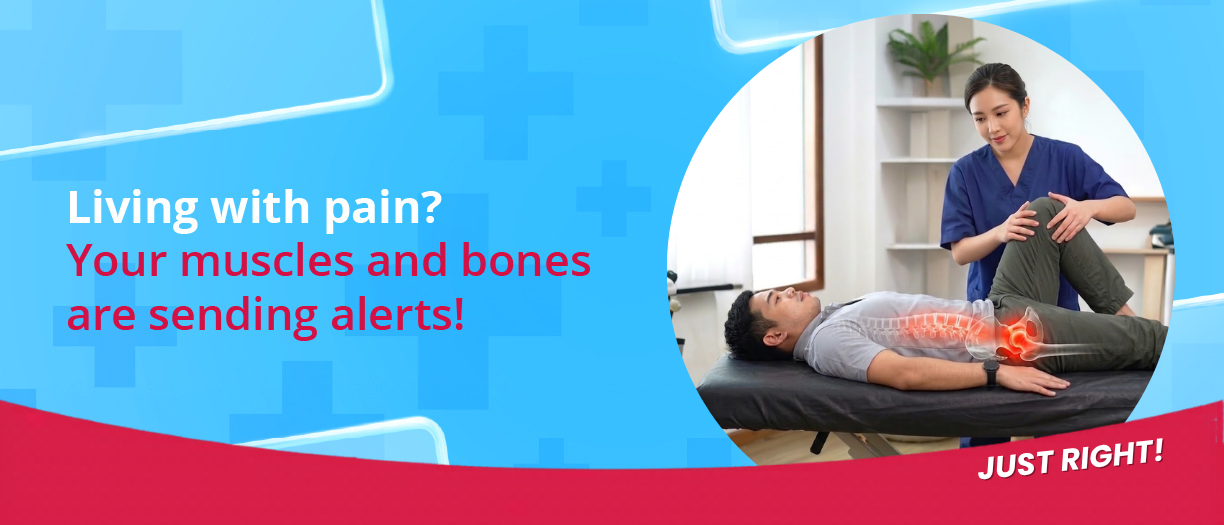
A sore knee after climbing stairs.
A stiff lower back after sitting too long.
A shoulder that suddenly hurts when reaching overhead.
Most people dismiss it at first.
“You’re just getting older.”
“It’s probably stress.”
“I’ll rest this weekend.”
“I don’t have time to deal with it now.”
And so, the pain becomes part of daily life.
People continue working, caring for their families, exercising through discomfort, or relying on temporary pain relief, while the underlying problem quietly progresses.
However, persistent musculoskeletal pain should not simply be “pushed through.”
Your body may already be asking for help.
Knee Pain
Knee pain is one of the most common musculoskeletal complaints globally and affects people of all ages, not only older adults. A key mistake to avoid is prolonged inactivity, as avoiding movement due to pain can worsen muscle weakness and joint stiffness.
Common knee problems:
1. Knee Osteoarthritis
It is especially common after age 40 and may gradually lead to stiffness, swelling, reduced mobility and pain while walking or climbing stairs.
2. Meniscus Tears or Ligament Damage
- Sudden twisting injuries may cause meniscus tears or ligament damage, particularly in physically active individuals.
- Many people delay seeking medical advice and continue high-impact activities despite ongoing pain, potentially worsening joint damage over time.
- Imaging findings alone should not determine treatment modalities. Many MRI abnormalities are incidental findings and do not require surgical intervention.
- Treatment options vary depending on the diagnosis and severity such as Physiotherapy and rehabilitation, Muscle strengthening and Anti-inflammatory medication.
- Surgery will be considered in selected cases, and mainly after conservative treatment has been tried and failed.
OUR TIPS TO YOU
Not every painful knee requires surgery, but a painful knee should not be ignored either. The primary goal is preserving long-term mobility, function and quality of life through accurate diagnosis and the right treatment strategy. Early assessment and a guided, personalised management plan can often prevent years of worsening pain and even disability.
LET US SUPPORT YOU IN MAKING THE RIGHT DECISION 
Low Back Pain
Low back pain is among the leading causes of disability worldwide and affects up to 80% of adults at some point in their lives. However, “Complete bed rest” is no longer recommended for most cases, as it may delay recovery.
- Common causes include muscle strain, disc degeneration or herniation, spinal stenosis, sciatica, poor posture, etc.
- In many cases, imaging such as MRI may show age-related changes that are not necessarily the true cause of pain. It is important to identify the root cause and personalise treatment approach accordingly.
- While severe or persistent symptoms may require medical intervention, most low back pain improves significantly with conservative treatment (e.g. core strengthening and pain management) rather than surgery.
- Treatment may include physiotherapy and exercise, posture correction, pain relief medications, core strengthening, weight management, acupuncture, and other supportive measures, etc.
OUR TIPS TO YOU
Many people treat low back pain with repeated painkillers while ignoring the root cause: movement patterns, posture, muscle weakness and lifestyle factors. Pain relief alone is not the only treatment. The earlier the right treatment begins, the better the long-term outcome often becomes.
LET US SUPPORT YOU IN MAKING THE RIGHT DECISION
Preventive and Lifestyle: Caring for Your Musculoskeletal Health
Musculoskeletal health is deeply connected to lifestyle and daily habits.
Many joint and spine problems are worsened not only by aging, but by inactivity, poor posture, excessive weight, chronic stress and lack of muscle strengthening.
Here is some useful data to remind you to protect your long-term mobility and physical health:
Physical inactivity: Sedentary lifestyles significantly increase the risk of chronic back pain, joint stiffness and muscle weakness.
Weight and joint load: Excess body weight places increased stress on the knees, hips and lower back, accelerating joint degeneration.
Posture and ergonomics: Long hours sitting at desks, driving or using phones contribute to neck, shoulder and spinal strain.
Stress and muscle tension: Chronic stress is strongly associated with muscle tightness, pain amplification and reduced recovery.
Sleep: Poor sleep quality is linked to increased pain sensitivity, inflammation and slower tissue healing.
Musculoskeletal Health is Not Just About Pain, It Is About Mobility, Independence and Quality of Life
With the right support, early diagnosis and appropriate rehabilitation, many musculoskeletal conditions can be effectively managed before they become chronic or disabling.
Many people ignore the pain signal for far too long. Functional mobility matters the most. Your health deserves attention before pain becomes a limitation.
Blue Cross MSK Care Pathway
If you are experiencing persistent musculoskeletal pain, early and guided care can make a meaningful difference to long-term mobility and recovery. To support this journey, Blue Cross offers dedicated Health Concierge service under its Blue Cross MSK Care Pathway (“the Service”) — providing personalised coordination for appointments, treatment arrangements, and follow-up care. For more details, please click here or contact us directly at 28396333 to learn more.
OUR TIPS TO YOU
Avoid rushing into surgery without a clear diagnosis.
Avoid relying solely on MRI findings.
Avoid skipping rehabilitation.
When in need, contact Blue Cross MSK Care Pathway
LET US SUPPORT YOU IN MAKING THE RIGHT DECISION
Important Disclaimers of Blue Cross MSK Care Pathway
- Value‑Added & Non‑Contractual
- The Service is a value‑added service. It is optional, non-contractual and does not form part of the contractual terms and benefits of any insurance policy. The Service is non‑guaranteed. Blue Cross reserves the right to amend, suspend or terminate (in whole or in part) the Service, and/or change service providers, scope or terms at any time without prior notice.
- The Health Concierge and related coordination support under the Service may be provided by Blue Cross and/or by appointed third-party service providers from time to time. Medical and healthcare services (including diagnosis, treatment and clinical decisions) are provided solely by treating doctors, hospitals, clinics and other healthcare providers (collectively, “Healthcare Providers”), which are independent third parties. Healthcare Providers are not agents, representatives or employees of Blue Cross, and Blue Cross does not act as an agent or representative of any Healthcare Provider. Blue Cross makes no representation, warranty or undertaking as to the availability, continuity, timeliness, quality or outcome of the Service and/or any services provided by the Healthcare Providers and/or appointed third-party service providers (together, “Third-party Services”, including any Health Concierge support when provided by an appointed third-party service provider). To the extent permitted by law, Blue Cross shall not be responsible or liable for any act, omission or negligence of any Healthcare Provider or third-party service provider in connection with any Third-party Services (including but not limited to any diagnosis, treatment and medical and healthcare services).
- No Medical Advice
The Health Concierge provides administrative coordination and general information only. The Service (including any Health Concierge support and coordination support under it) does not constitute medical advice, diagnosis, treatment or recommendation. All clinical decisions are made by treating doctors and other Healthcare Providers.
- Fees & Charges
- Some coordinated services provided by Healthcare Providers or third party vendors may involve fees payable by the insured, unless otherwise covered under the applicable policy.
- Actual costs depend on clinical needs, provider pricing, location, and policy coverage, benefit limits and exclusions.
- Any references to cost management or affordability are not guarantees. Actual out of pocket expenses vary depending on medical needs, provider fees and policy coverage, benefit limits and exclusions.
- Not for Emergency Use
This Service is not intended for emergency or urgent medical situations. In case of emergency, please seek immediate medical attention.
Disclaimer:
The information contained herein is provided for general information only and does not constitute medical, health, legal, or professional advice. It is not intended to replace consultation with qualified healthcare professionals or other relevant advisers. Blue Cross (Asia-Pacific) Insurance Limited (the “Company”) does not guarantee the completeness or accuracy of the information. If you have any related questions, you should consult appropriate professional advisers. The Company shall not be liable for any loss, damages, compensation, legal costs, or other expenses or liabilities that may arise from reliance on any information contained herein.
This article is for distribution in Hong Kong Special Administrative Region only. All information relating to insurance products is provided for reference only and shall not be construed as an offer, solicitation, or invitation to sell or provide any insurance products to any person outside Hong Kong. The Company makes no express or implied representation, statement, or warranty as to the accuracy, completeness, or fitness of the information for any particular purpose. Insurance products may differ among insurance companies. Prior to purchasing any insurance product, you should fully understand, analyze, and compare the relevant products in order to select the one that best suits your needs.
Blue Cross (Asia-Pacific) Insurance Limited is a subsidiary of AIA Group Limited. It is not affiliated with or related in any way to Blue Cross and Blue Shield Association or any of its affiliates or licensees.